Why is Chillon Castle so famous?
Why Château de Chillon, the water castle near Montreux on Lake Geneva in Switzerland, is the country's most-visited monument, from Lord Byron's poem to its rock-island setting and how to reach it by boat. This is Lac Léman, not Wisconsin.
 By Camille Rochat, Lake Geneva cruise specialist
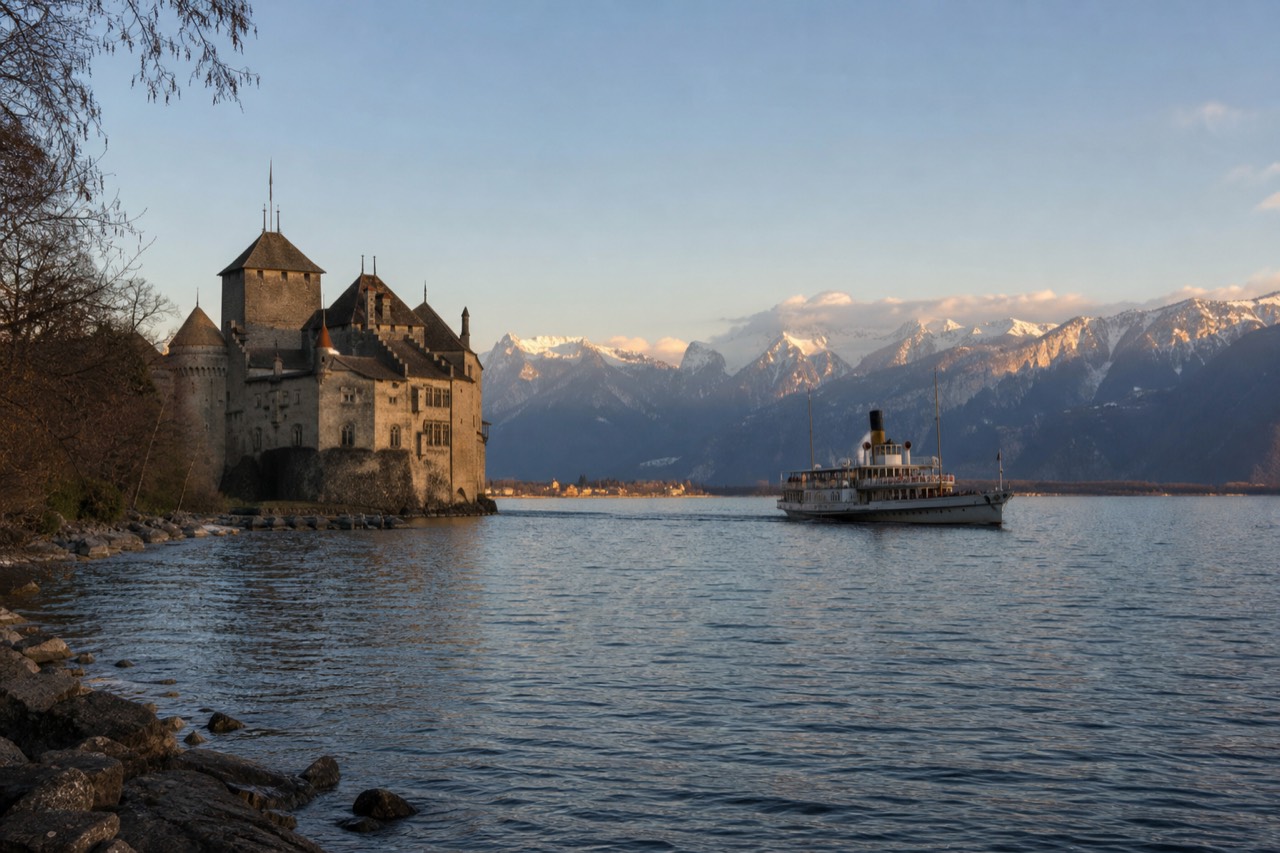
The first thing you notice is that the castle sits in the water, not above it. Château de Chillon stands on a small rock island a few metres off the shore at Veytaux, between Montreux and Villeneuve at the eastern end of Lac Léman, with the lake lapping its stone walls and the Alps rising straight across the water. This is Lake Geneva in Switzerland, the crescent lake shared with France, not the small resort lake in Wisconsin that a lot of US searches surface first. And of all the sights on this shore, the one people travel furthest to see is this squat, turreted fortress that looks like it grew out of the lakebed. A castle admission ticket lets you follow the story through the historic rooms; the lake approach is a separate experience.Explore Chillon Castle admission
So why is a medieval castle on a Swiss lake one of the most recognised buildings in the country? The short version is a rare mix of setting, story and staying power. Here is the longer version, with the real numbers behind its fame and the honest way to see it from the water.
Why is Château de Chillon so famous?
Château de Chillon is famous because it combines a spectacular position on a rock island in Lake Geneva with a thousand years of history and a starring role in Romantic literature, above all Lord Byron's 1816 poem The Prisoner of Chillon. It is Switzerland's most-visited historic monument, drawing well over 400,000 visitors a year.
Three things stack up to make this castle stand out from the many fortresses in the Alps. The setting comes first: a water castle on its own island, framed by vineyards behind and the Savoy Alps in front, is simply photogenic in a way a hilltop keep is not. The history comes second: Chillon guarded the strategic road between northern Europe and Italy for centuries, and its walls hold the layers of the House of Savoy, a Bernese occupation, and later Vaud statehood. The literature comes third and may matter most, because Byron turned a real prisoner in the dungeon into a poem that sent travellers here for two hundred years.
Put those together and you get a monument that is at once a genuine archaeological site, a Romantic pilgrimage and one of the most photographed spots in Switzerland. The Château de Chillon Foundation, which runs the site today, records the visitor numbers that make the fame concrete, and the castle's own pages at chillon.ch lay out the history room by room.
| Château de Chillon at a glance | Detail |
|---|---|
| Location | Rock island off Veytaux, between Montreux and Villeneuve |
| Status | Switzerland's most-visited historic monument |
| Visitors in 2025 | Nearly 422,000, the second-highest year on record |
| International share of visitors | About 77 percent |
| Adult admission (2026) | CHF 15 (child CHF 7) |
| Reached by boat | CGN landing stage right beside the castle |
The castle earns most of its visitors from abroad, which tells you how far its reputation travels.
Everything on Lake Geneva Cruises that reaches this shore is priced honestly in Swiss francs with the real duration attached, so you can see what the boat fare covers before you click through, and remember that castle admission is always a separate ticket.
What did Lord Byron have to do with Chillon's fame?
Lord Byron visited Chillon in June 1816 and wrote The Prisoner of Chillon, a narrative poem about François Bonivard, a Genevan monk and patriot chained in the castle's dungeon from 1530 to 1536 by the Duke of Savoy. The poem became a Romantic landmark, and Byron is said to have carved his name on a pillar in that same dungeon.
The story behind the poem is real, which is part of why it landed so hard. Bonivard backed Geneva's independence against the Savoyards, was captured, and spent six years shackled to a pillar in the vaulted underground chamber where the lake water is close enough to hear. Byron, touring the lake with Percy Shelley during the famously wet summer of 1816, went to see the spot, and the poem he produced turned Bonivard into a symbol of liberty crushed by tyranny. Readers across Europe took it up, and Chillon went from a regional fortress to a name people knew before they ever reached Switzerland.
Byron was not the only writer the castle pulled in. Jean-Jacques Rousseau had already woven the lake and its shore into his 1761 novel Julie, or the New Héloïse, which drew earlier Romantic travellers to this exact stretch of water. Later, Victor Hugo, Alexandre Dumas and Gustave Flaubert all wrote about or visited Chillon. That literary pile-up matters because it kept the castle in the cultural conversation for generation after generation, long after its military purpose was gone. A fortress that inspires poems gets visited; a fortress that only guarded a road gets forgotten.
| Writer | Work | Connection to the lake and castle |
|---|---|---|
| Lord Byron | The Prisoner of Chillon (1816) | Wrote it after visiting the dungeon; the pillar carving bears his name |
| Jean-Jacques Rousseau | Julie, or the New Héloïse (1761) | Set his novel on this shore, drew the first Romantic travellers |
| Percy Bysshe Shelley | Letters and journals, 1816 | Toured the lake with Byron the summer the poem was written |
| Victor Hugo | Travel writing | Visited and praised the castle in the 19th century |
| Alexandre Dumas | Travel impressions | Wrote about Chillon on his Swiss travels |
How old is the castle, and who actually lived there?
Château de Chillon has roughly a thousand years of building history. The site was fortified by the 11th century, expanded by the House of Savoy from the 12th to 13th centuries into the castle you see today, then held by Bern from 1536 after Vaud fell to the Bernese, and finally became property of the canton of Vaud in 1803. It was a residence, a toll station and a fortress in turn.
The reason the castle looks so complete is that it was continuously occupied and rebuilt rather than left to fall down. The Savoy counts made it a lakeside residence and a customs point on the vital trade route between the Alpine passes and the plains, taxing the goods that moved along the shore. Their engineers gave it the ring of towers, the great halls with painted ceilings, the courtyards and the dungeon carved into the living rock. When Bernese troops took Vaud in 1536, they turned Chillon into an arsenal and a state prison, which is the period that later fed the Bonivard legend. From 1803 the young canton of Vaud inherited it as a public monument, and restoration work through the 19th and 20th centuries stabilised what survives.
That long, unbroken use is unusual. Many castles this old are ruins; Chillon still has floors, ceilings, furniture and frescoes, so a visit reads as a walk through a lived-in building rather than a scramble over rubble. The myswitzerland.com heritage pages set the castle in the wider story of the lake, and the layers are easy to trace once you know the sequence: Savoy first, Bern second, Vaud last.
If you want the full mechanics of arriving, the boat fares, the landing stage and the separate castle ticket, the guide to reaching Château de Chillon by boat walks through every route and pier. For a straight up-or-down call on the interior, the companion post on whether it is worth going inside Chillon Castle weighs the admission against what you actually see.
Is Chillon really Switzerland's most-visited monument?
Yes. Château de Chillon is Switzerland's most-visited historic monument, and it is not close. The castle welcomed nearly 422,000 visitors in 2025, up about 6 percent on 2024 and the second-best year in its recorded history, just behind the 2019 peak of around 432,000. Around 77 percent of those visitors came from outside Switzerland.
Numbers this size are what separate a famous castle from a merely handsome one. Roughly four hundred thousand people a year is a steady river of visitors arriving by boat, train, bus and car, and the fact that more than three in four come from abroad shows how far the reputation reaches. The castle sells online tickets partly to manage that flow, and the busiest months track the main cruise season, when the CGN boats run their fullest timetable and the terraces above the lake are green.
The scale also explains why timing matters so much. A monument pulling this many people has real crowd peaks, so a midweek morning or a late afternoon in the shoulder weeks is a very different experience from a July Saturday. That is worth planning around, and it is one reason arriving by scheduled boat can beat driving: you skip the car park, and the approach across the water is the view the castle was built to command.
Is the castle the reason the whole lake is famous?
Chillon is one of several reasons Lac Léman is famous, not the only one. The lake's reputation also rests on Geneva and its Jet d'Eau, the UNESCO Lavaux vineyard terraces, the Belle Époque paddle steamers and the Montreux Jazz Festival, with the castle as the single most-photographed building. Chillon concentrates the lake's appeal into one frame, which is why it so often stands in for the whole.
The lake carried fame well beyond the castle. The same Romantic writers who made Chillon famous, Rousseau, Byron and Shelley, wrote about the water itself, and the lake grew its own reputation through the 19th-century Grand Tour, the vineyards and the heritage fleet. The wider story of what draws people to the whole of Lac Léman, from the fountain at Geneva to the terraces and the towns, is set out in the post on why Lake Geneva is so famous.
The castle becomes the emblem because it is the most concentrated image the lake offers. Low on the water with vineyards behind and the Alps in front, it packs the whole appeal into one composition, so it ends up as shorthand for Lac Léman on posters and postcards even though the fame is shared across the shore. A hilltop keep photographs as a building; Chillon photographs as the lake.
That shared fame is also why a visit rarely feels like a single-sight trip. Arrive by boat and the castle comes wrapped in the things that made the lake famous in the first place: the vineyard terraces sliding past on the way down, the lake beneath your boat, the Alps standing across the water. The monument is the headline, but the setting is the story, and the two reinforce each other. It is the reason a single photograph from the deck can hold a Swiss castle, a wine-growing landscape and the French Alps at once, and why that image travels so far.
| Why Lac Léman is famous | What it is |
|---|---|
| Château de Chillon | The most-photographed water castle in Switzerland |
| Geneva and the Jet d'Eau | The landmark fountain in the city harbour |
| Lavaux vineyard terraces | UNESCO-listed slopes best seen from the water |
| Belle Époque paddle steamers | The largest heritage paddle fleet on any lake |
| Montreux Jazz Festival | A world-known music festival on the Riviera |
Why is the setting itself so photographed?
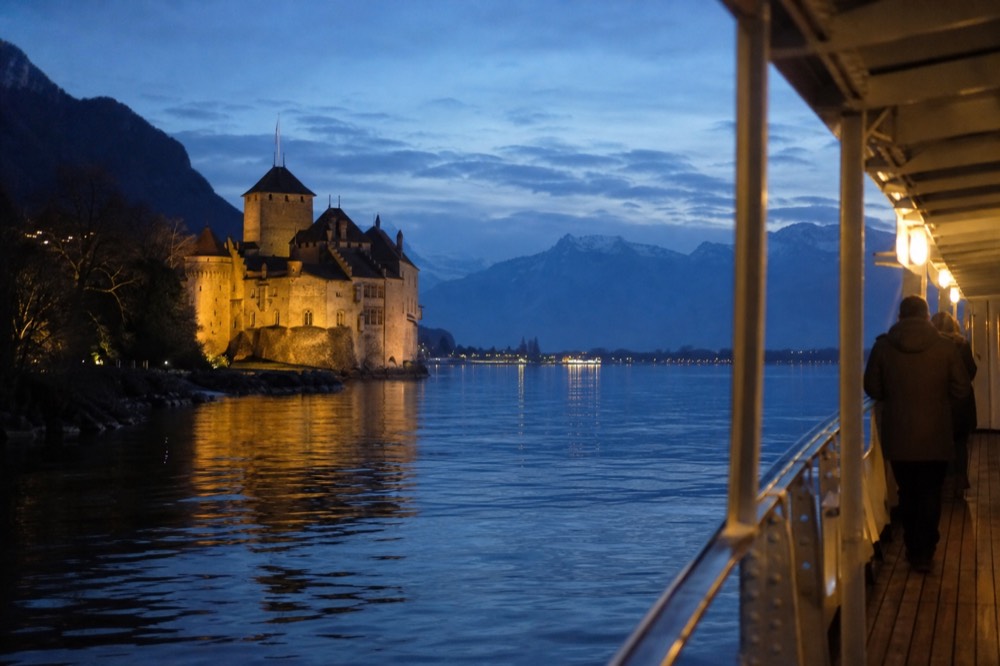
Chillon photographs so well because it is a compact castle on its own rock island, low against the water, with three natural backdrops that change through the day: the Riviera slopes behind it, the wide sweep of Lac Léman around it, and the Savoy Alps rising directly across the lake. From a boat, the whole silhouette reflects in the water.
Most famous castles sit up high, so you photograph them looking up, with sky behind. Chillon is the opposite. It sits almost at water level, which means from the lake you get the towers, their reflection, and the mountains all in one frame, with no need to crane upward. The stone changes colour through the day, warm in the golden hour of late afternoon, cool and silver under an overcast sky, and the water in front acts like a mirror on a calm morning.
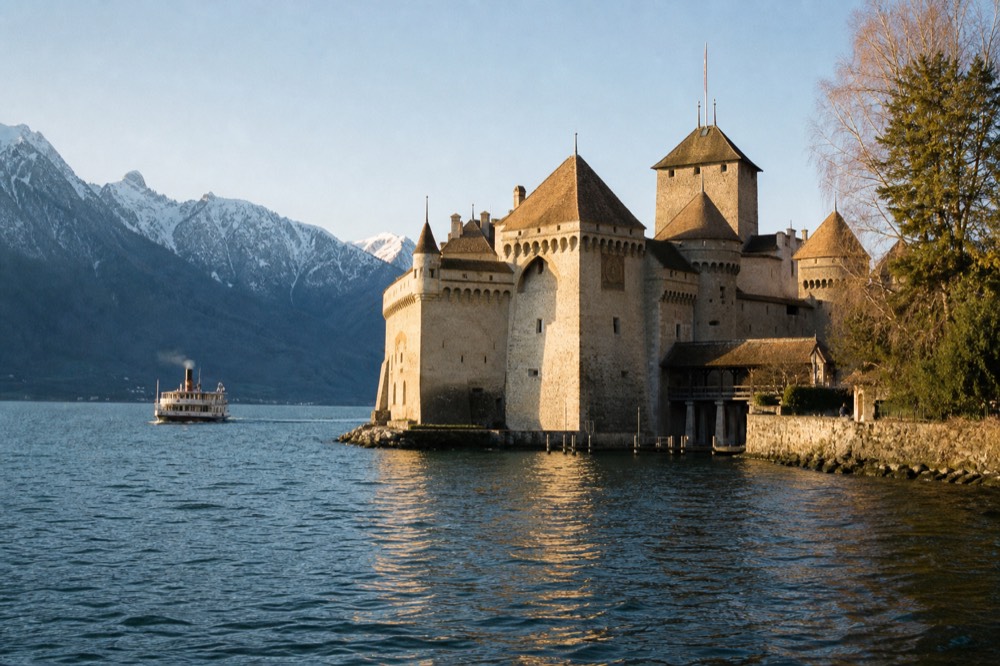
That low, island setting is also why the boat approach is the classic view. Painters and photographers have worked this angle since the 19th century, and the modern version is the deck of a CGN boat easing toward the Veytaux landing stage. The UNESCO-listed Lavaux vineyards lie farther west along the lake, and the far shore is France, so a single photograph from the water can hold a Swiss monument, a wine-growing landscape and the French Alps at once. For the vineyard side of that picture, the Lausanne to Chillon route runs the length of Lavaux on the way down.
How do you actually reach Chillon by boat?
A scheduled CGN boat from Montreux runs to the Chillon landing stage and back in about two hours, often on a Belle Époque steamer, from roughly CHF 32 per person. A longer route from Lausanne-Ouchy passes the Lavaux vineyards on the way. In both cases the boat fare gets you to the landing stage, and castle admission is a separate ticket.
This is the single most important practical point, and the one that trips people up. The boat and the castle are two purchases. The CGN sailing carries you to the dedicated landing stage at Quai Alfred Chatelanat in Veytaux, a short walk from the castle gate, but it does not include entry. You buy admission at the castle or online, currently CHF 15 for an adult, CHF 7 for a child, unless a specific listing bundles the cruise and the ticket together. Budget for both if you plan to go inside.
Prices show in Swiss francs because that is what the operator charges at the pier; the booking platforms then convert to your own home currency at checkout, so an American sees dollars and a Briton sees pounds. The Montreux round trip is the direct option and the one most people take. Montreux offers a two-hour Riviera cruise with a Chillon stop option; Lausanne offers a longer Lavaux-and-castle route.
| Way to reach Chillon | Rough time from the departure point | Note |
|---|---|---|
| Scheduled boat from Montreux | About 2 hours round trip | Direct, often a Belle Époque steamer, from about CHF 32 |
| Scheduled boat from Lausanne-Ouchy | Half day round trip | Passes the Lavaux vineyard terraces on the way |
| Riviera loop cruise | 2 hours | Tracks the Chillon and Vevey shoreline, castle from the water |
| Train to Veytaux-Chillon station | A few minutes from Montreux | Cheapest, but you miss the lake approach |
| Bus 201 to Veytaux, Château de Chillon | A short hop along the shore | Local transport, no lake views |
What is the best way to see Chillon on the water?
The best on-water way to see Chillon depends on how long you want on the lake. For a focused visit, the two-hour Montreux round trip drops you right at the castle. For scenery first, a two-hour Riviera loop from Montreux or Vevey tracks the same shoreline, and the Gold option of a full-day trip from Geneva pairs Lavaux with a steamer leg from June to September.
If the castle is the whole point, take the direct Montreux run and give yourself a couple of hours inside. If you want the postcard sweep of the Riviera with the castle as one highlight among several, the two-hour loop from Montreux or the quieter departure from Vevey shows you the Chillon shoreline, the vineyards and the Alps in one circuit. And if you are coming from the Geneva end for the day, the Gold option of the packaged trip strings together Lavaux, Montreux and a heritage-boat leg from June to September, which puts you aboard one of the historic paddle vessels the lake is known for.
The Riviera cruise from Vevey deserves a mention on its own, because it is the same water as Montreux boarded a stop earlier, usually with a smaller crowd on deck. Whichever you pick, the honest rule holds: the boat is the scenery, the castle is a separate ticket, and the two together make the eastern end of the lake the trip most people travel for.
Common questions about Chillon Castle's fame
Why is Chillon Castle so famous?
It combines a rare setting, a water castle on a rock island in Lake Geneva, with a thousand years of history and a starring role in Romantic literature, especially Lord Byron's 1816 poem The Prisoner of Chillon. It is Switzerland's most-visited historic monument.
What is The Prisoner of Chillon about?
Lord Byron's 1816 poem tells the story of François Bonivard, a Genevan patriot chained in the castle's dungeon from 1530 to 1536 by the Duke of Savoy. Byron wrote it after visiting the dungeon, and his name is said to be carved on one of its pillars.
How many people visit Château de Chillon each year?
The castle drew nearly 422,000 visitors in 2025, its second-highest total on record after the 2019 peak of about 432,000. Around 77 percent of visitors come from outside Switzerland, which makes it the most-visited historic monument in the country.
Does the boat fare to Chillon include castle admission?
No. The boat fare, from about CHF 32 for the round trip from Montreux, carries you to the Chillon landing stage beside the castle. Admission is a separate ticket, currently CHF 15 for an adult and CHF 7 for a child, unless a specific listing bundles the two.
Is Chillon in Lake Geneva, Switzerland or Wisconsin?
Switzerland. Château de Chillon stands on Lac Léman, the lake shared by Switzerland and France, at Veytaux between Montreux and Villeneuve. It has no connection to Lake Geneva in Wisconsin, which is a separate US lake with no such castle.
Choose Your Lake Geneva Experience
Have a date for Chillon? Check castle admission before fixing your boat or train arrival, and allow time for the full visit.
Chillon Castle Entrance Ticket
Explore Chillon’s halls, courtyards and lakeside fortress at your own pace, with an English brochure.
Compare options and tailor this choice
- Inside the castle: Admission includes an English brochure; audio guide extra. Allow 1–2 hours. Audio guide, boat travel and meals extra. Not wheelchair accessible; strollers and pets are not admitted.
- The castle approach from Montreux: Riviera cruise and optional timetable-dependent stop; entry extra. Castle admission extra. Allow separate visiting time and confirm the return sailing.
- Lavaux and the castle from Lausanne: Three-hour cruise; time inside castle additional. Ouchy departure. Allow 3 hours; confirm your selected sailing and any stopover. Meals and castle entry extra.
Initial recommendation. Confirm the selected option, suitability and departure on the booking page.
Scheduled dates from Viator. Final availability and price are confirmed on Viator.
Allow 1–2 hours. Audio guide, boat travel and meals extra. Not wheelchair accessible; strollers and pets are not admitted.