Why is Lake Geneva, Switzerland famous?
Why is Lake Geneva in Switzerland famous? The Jet d'Eau, the Château de Chillon, the UNESCO Lavaux vineyards, the Belle Époque paddle steamers, Montreux Jazz and a long literary and diplomatic history, all on Lac Léman between Geneva and Montreux. This is the Swiss lake, not Wisconsin.
 By Camille Rochat, Lake Geneva cruise specialist
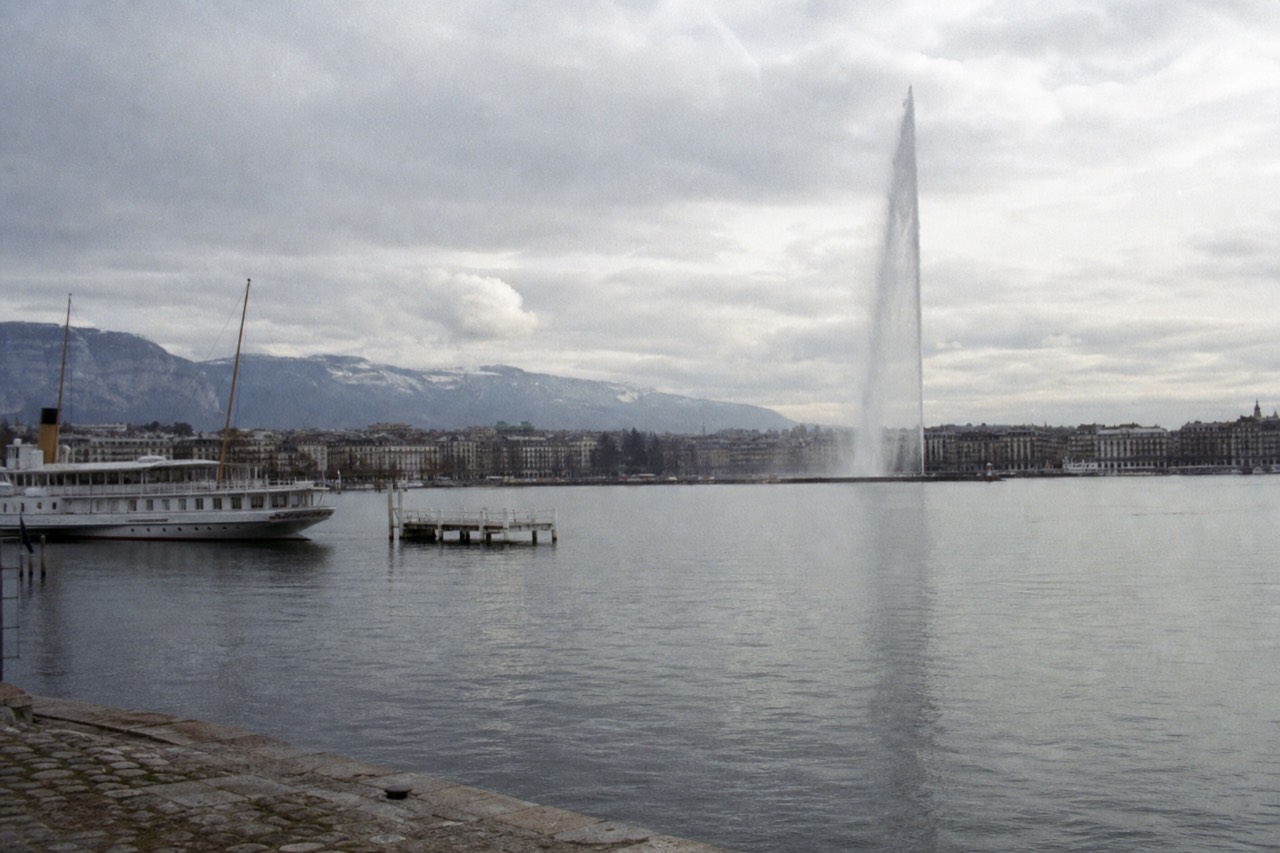
The tallest water fountain in the world once stood here, and a version of it still shoots a plume 140 metres over Geneva harbour every day. That fountain, the Jet d'Eau, is the single image most people picture when they hear the name, and it is a fair place to start, because it sits at the western tip of Lac Léman, the crescent-shaped Swiss lake that this page is about. Not Lake Geneva, Wisconsin, the small US resort lake that tends to top American search results, but the big one shared between Switzerland and France, with the Alps across the water and a medieval castle at its far end. For Lavaux and the Chillon shoreline together, the Lausanne cruise gives a concrete way to see the eastern lake.Explore the Lavaux and Chillon cruise
The lake's fame is not built on one thing. It is a stack of them: a giant fountain, a storybook castle, a UNESCO wine landscape, a fleet of century-old paddle steamers, a jazz festival with a global name, and centuries of writers, scientists and diplomats who lived or gathered on its shores. This page works through each reason it is famous, keeps the facts real, and points out where the best of it can be seen from the deck of a boat.
Why is Lake Geneva, Switzerland famous?
Lake Geneva is famous for the Jet d'Eau fountain in Geneva, the Château de Chillon (Switzerland's most-visited monument), the UNESCO-listed Lavaux vineyard terraces, and its fleet of Belle Époque paddle steamers. Add Montreux with its jazz festival and Freddie Mercury statue, plus a literary and diplomatic history from Byron to the League of Nations, and its reputation is well earned.
Fame usually comes down to a handful of images that travel well, and this lake owns several. The Jet d'Eau is the postcard for the whole of Geneva. The Château de Chillon has been painted, photographed and written about for two centuries. The Lavaux terraces are one of the most recognisable working landscapes in Europe. Any one of these would put a place on the map; the lake carries all of them, but Geneva and the Riviera require separate route planning.
Behind the images sits substance. The lake is one of the largest in Western Europe, a real transport artery with scheduled boats running between its towns, and a stretch of shoreline that has drawn exiled poets, treaty negotiators and festival crowds for a very long time. The sections below take the reasons one at a time.
That geography, one shore holding fountain, vineyards and castle, is exactly why Lake Geneva Cruises organises its trips by the town you set off from, so you can reach the specific landmark you came to see.
Why is the lake itself so notable?
Lac Léman is one of the largest lakes in Western Europe, covering roughly 580 square kilometres and stretching about 73 kilometres in a broad crescent. The Rhône flows in at the eastern end and out through Geneva at the west. Switzerland holds about sixty percent of it and France the rest, which makes it a shared, cross-border lake.
Size is the first fact people cite, and it is a real one. The lake is big enough to have its own weather, its own winds with local names, and a horizon that hides the far shore on a hazy day. That scale is why the towns around it feel like a string of separate destinations rather than a single lakeside, and why a boat network grew up to link them in the first place.
The shape matters too. The narrow western arm, the Petit Lac, runs from Geneva out past Nyon and Coppet, while the wide eastern basin, the Haut-Lac, holds the Riviera and the castle. The Rhône passes through the whole lake, entering muddy from the Alps and leaving clear at Geneva, which is part of why the water reads that deep blue-green in photographs. For the geographic detail, the Britannica entry lays it out.
The lake also makes its own weather, which is part of lakeside life here. A cold north wind called the bise can whip up short, sharp waves and scrub the sky to a hard blue, while autumn and winter mornings often bring a low fog that hides the far shore entirely. Both can pause the boats without much notice, so the timetable always carries a quiet note of the lake's own temperament. The by-the-numbers table gathers the headline figures.
| Feature | Figure |
|---|---|
| Surface area | about 580 square kilometres |
| Length | about 73 kilometres, crescent shape |
| Shared between | Switzerland (~60%) and France (~40%) |
| River through it | the Rhône, in from the east, out at Geneva |
| Main operator's fleet | about 19 vessels |
| Passengers carried in 2025 | about 2.6 million |
What is the Jet d'Eau, and why is it so photographed?
The Jet d'Eau is a water fountain in Geneva's harbour that throws a jet about 140 metres into the air, one of the tallest in the world. It began as a pressure-release valve for a hydraulic plant in the 1880s and became the city's emblem. Visible across the lake and lit at night, it is the defining image of Geneva.
The fountain's origin is a good story precisely because it was an accident of engineering. A plant releasing surplus water pressure produced a spectacular plume, the city liked it, and by the early twentieth century it had been moved to the harbour and turned into a deliberate landmark. Today it pumps lake water at high speed and holds several hundred litres in the air at any moment.
Powerful pumps drive the water upward at high speed, so several hundred litres hang in the air at any moment. When the wind is calm the plume stands almost perfectly vertical, which is how it appears in most photographs; on a gusty day the bise bends it into a long banner across the harbour, and in hard frost it is switched off to stop ice forming on the promenade.
For visitors, the Jet d'Eau is the anchor of a Geneva stop: the Old Town, the flower clock, the parks and the international quarter all sit within walking distance of the waterfront that frames it. The best angle on it, though, is from the lake, where the scheduled boats pass close by and give you the fountain with the city and, on a clear day, Mont Blanc behind. The fifty-minute Geneva loop covers this city-side stretch of the lake.
Why is the Château de Chillon so well known?
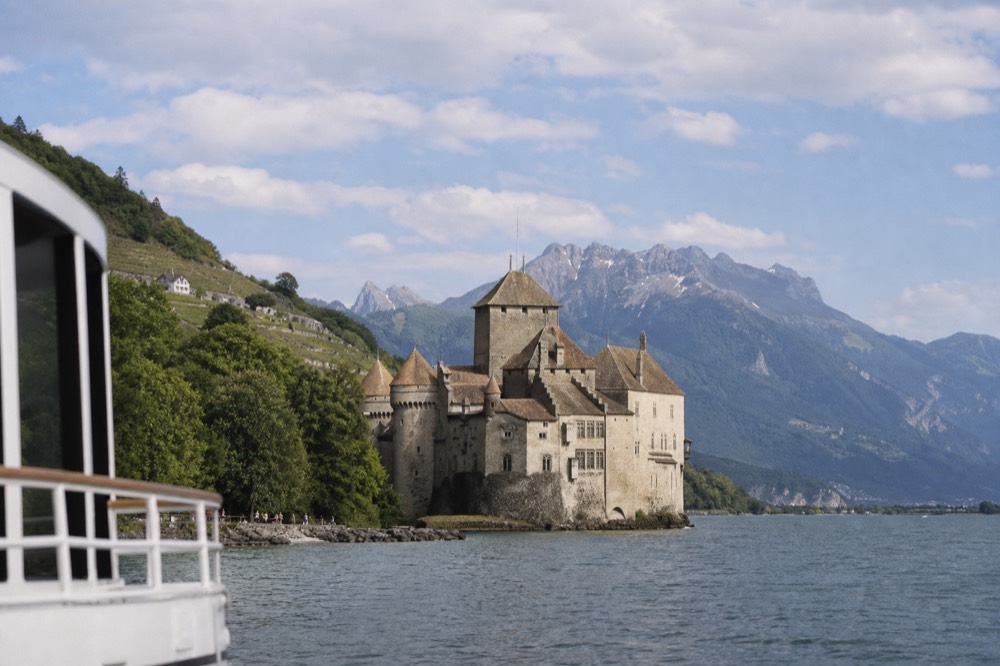
The Château de Chillon is a medieval water castle near Montreux, built on a rock at the lake's edge, and it is Switzerland's most-visited historic monument. It drew close to 422,000 visitors in 2025. Lord Byron's 1816 poem "The Prisoner of Chillon" cemented its literary fame, and its walls have been painted and photographed ever since.
Chillon earns its reputation on both looks and story. The castle rises straight from the water, so it photographs as a self-contained island fortress, and its underground vaults, where a monk named Bonivard was chained in the sixteenth century, gave Byron the subject for one of the Romantic era's most famous poems. Byron reportedly carved his name into a pillar; the graffiti is still shown to visitors.
The numbers back the fame. In 2025 the castle recorded close to 422,000 visitors, its second-best year on record and just short of the 2019 peak, with international guests making up more than three-quarters of the total. Arriving by water gives a close view of the castle before landing; allow extra time for any visit inside. The boat fare and the castle admission are separate tickets, though; adult entry has held at CHF 15, listed on the Château de Chillon visitor pages. For a fuller account of the castle's story, the post on why Chillon Castle is so famous goes deeper.
Why are the Lavaux vineyards UNESCO-listed?
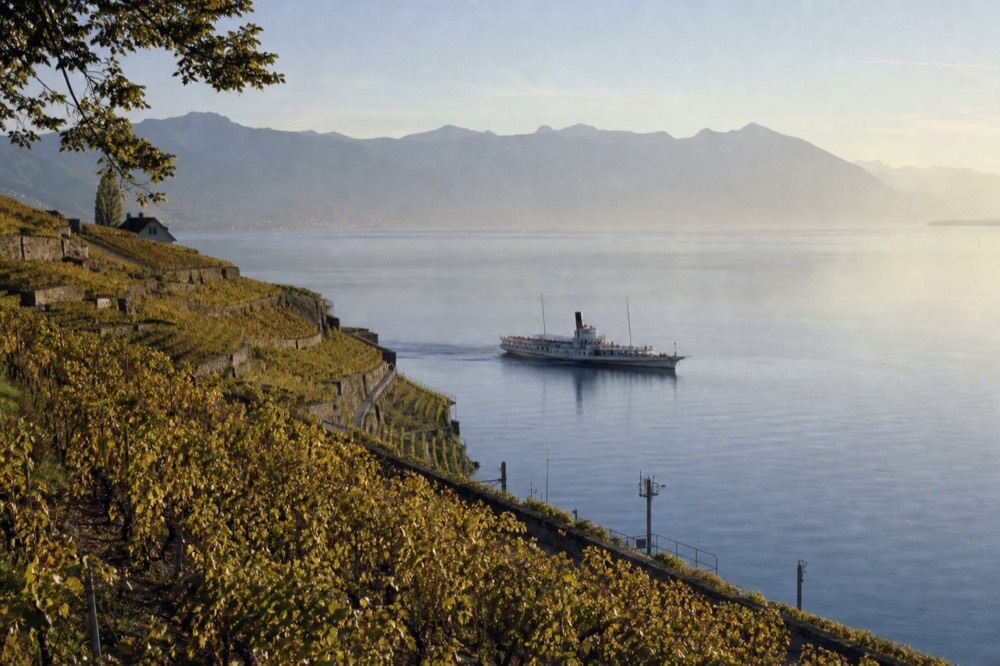
The Lavaux terraces are a UNESCO World Heritage site inscribed in 2007, a landscape of stone-walled vineyards climbing the north shore between Lausanne and Montreux. Farmed since the eleventh century by monks, they grow mostly Chasselas white grapes across roughly 800 hectares, and they are widely described as best seen from the water.
Lavaux is famous as a made landscape rather than a wild one. Generations of growers built the terraces by hand, wall by wall, on slopes too steep to farm otherwise, and the result is thirty kilometres of vineyards held up on stone. UNESCO recognised it in 2007 as an outstanding example of a cultural landscape shaped over nearly a thousand years. Locals talk about three suns ripening the grapes: the sky, the reflection off the lake, and the heat stored in the walls.
The signature grape is Chasselas, a delicate white that expresses the differences between sub-appellations like Dézaley, Epesses and Saint-Saphorin. The terraces sit directly above the boat route, which is why the cruises trace them so closely; the UNESCO listing sets out why the site qualifies. The three-hour Lausanne cruise offers a sustained lake view; the Lavaux vineyard cruise guide covers the water approach. For the wider list of what fills a lake day, the round-up of things to do around the lake ranks the sights.
| Lavaux fact | Detail |
|---|---|
| UNESCO status | Inscribed 2007, cultural landscape |
| Length of terraces | about 30 kilometres of vineyards |
| Area under vine | roughly 800 hectares |
| Main grape | Chasselas, a white variety |
| Farmed since | the 11th century, monastic origins |
| Best seen from | the water, along the CGN Riviera route |
What are the Belle Époque paddle steamers?
CGN operates the largest fleet of Belle Époque paddle steamers on any lake: eight historic vessels built between 1904 and 1927. For the 2026 season, five of them, the Rhône, Savoie, Montreux, Italie and Vevey, were planned for the main tourist cruises. Riding one of these restored boats is a sight in its own right, not just transport.
The steamers are a genuine piece of maritime heritage still in daily service. The oldest, Montreux, dates to 1904; the flagship La Suisse, launched in 1910, carries around 850 passengers. Several keep their original steam engines, brass and woodwork, while others were converted to diesel-electric drive over the decades. Together they make the lake one of the last places in Europe where you can cross open water on a genuine early-twentieth-century paddle steamer as a scheduled service.
Not every trip puts you aboard one, so it pays to check the boat before you book if the steamer is the point. The Château de Chillon crossings and some Riviera runs are common assignments, and a full-day package can string a steamer leg together with the vineyards and Montreux. The CGN fleet pages list the vessels, and the guide on the Belle Époque paddle steamers explains which trips actually sail on one. If you are comparing Lac Léman with the other Swiss lakes before you commit, the post on which lake cruise is best in Switzerland sets them side by side. The table below lists the historic fleet.
| Steamer | Launched | Note |
|---|---|---|
| Montreux | 1904 | Oldest of the fleet, steam |
| Vevey | 1907 | Diesel-electric, restored |
| Italie | 1908 | Diesel-electric |
| La Suisse | 1910 | Flagship, about 850 passengers |
| Savoie | 1914 | Steam |
| Simplon | 1920 | Steam, large capacity |
| Helvétie | 1926 | Diesel-electric |
| Rhône | 1927 | Steam, youngest of the eight |
Why is Montreux famous, and what about its music history?
Montreux is famous for its lakeside setting and its music. The Montreux Jazz Festival, whose 60th edition ran 3 to 18 July 2026, draws global names each summer, and a bronze statue of Freddie Mercury stands on the promenade where Queen recorded and the singer lived. The mild lakeside climate keeps palm trees alive along the front.
Montreux turned a beautiful setting into a cultural brand. The jazz festival, founded in 1967, grew into one of the best-known music events in Europe and now spreads more than 700 free lakeside performances around its ticketed concerts. Queen recorded several albums at a studio in the town, and Freddie Mercury kept a home on the lake; the statue unveiled in 1996 has become a pilgrimage point, freshly refurbished in 2026 for its thirtieth anniversary.
The town's fame is a magnet that pulls visitors onto the water, because the Riviera cruises leave from the Montreux promenade and the Château de Chillon sits a short sail south. Beyond the summer festival, the Freddie Days weekend in early September and the Montreux Noël Christmas market in late November and December keep the calendar busy. The companion post on whether Montreux is worth visiting weighs it against quieter Vevey next door. If you are still deciding whether the lake as a whole is worth the trip, the post on whether Lake Geneva is worth visiting makes the case. The cultural calendar below shows the main 2026 dates.
| Event | 2026 dates | What it is |
|---|---|---|
| Montreux Jazz Festival | 3 to 18 July | 60th edition, global music lineup |
| Freddie Days | 2 to 6 September | Free festival, statue's 30th anniversary |
| Fête des Vendanges, Lutry | late September | Lavaux harvest festival, since 1921 |
| Montreux Noël | 20 November to 24 December | Lakeside Christmas market, 150+ chalets |
What made the lake famous in history and culture?
The lake has drawn writers, exiles and diplomats for centuries. Rousseau and Voltaire lived near Geneva, Byron and the Shelleys spent the "year without a summer" of 1816 on its shores, and the League of Nations chose Geneva as its seat after 1919. That mix of literary romance and international diplomacy gave the lake a fame beyond its scenery.
The Romantic writers did much of the early publicity. In 1816, Byron and the Shelleys rented houses near the lake, and a rainy summer indoors produced both Byron's Chillon poem and Mary Shelley's "Frankenstein". Earlier, Rousseau set part of a hugely popular novel on these shores, and Voltaire settled just outside Geneva. Their pages sent generations of readers to see the lake for themselves.
The twentieth century added a different kind of fame. Geneva became a capital of diplomacy, home to the League of Nations after the First World War and later a major United Nations hub, with the international quarter still visible from the lake. The physics laboratory at CERN, straddling the border nearby, kept the region in the headlines for science. So the lake's reputation is layered: scenery on top, then literature, then the serious business of treaties and research underneath. That depth is part of why it holds attention the way it does.
What is the best way to experience the famous sights?
A scheduled boat is the way to line up the famous sights, because the fountain, the vineyards and the castle all face the water. A short Geneva loop covers the Jet d'Eau, a Riviera cruise takes in Lavaux and the Montreux shore, and the Chillon crossing reaches the castle. A private aperitif charter suits an occasion rather than sightseeing.
The reasons the lake is famous happen to be the reasons a cruise works so well. The Jet d'Eau was built to be seen across open water. Lavaux was terraced to be read from below. Chillon rises from the lake itself. A boat is the single vantage that connects them, and the operator runs it as ordinary scheduled transport at real prices, so you are not paying a premium for the best view; you are often paying the cheapest fare for it.
One practical note ties the fame to the ticket. Because the operator runs about nineteen vessels as scheduled service, a CGN day pass or a Swiss Travel Pass usually covers the sightseeing sailings outright, so the best views of the fountain, the vineyards and the castle can cost nothing extra beyond a pass you may already hold. The tourist cruises cluster in the warmer half of the year, roughly late April to mid-October, with the fullest timetable across the summer, so that stretch is when the famous sights are easiest to line up from the water.
Pick the trip to the sight you care about most. If the fountain and the city are the draw, the Geneva loop is enough. If the postcard vineyards and the castle are the goal, a Riviera or Lavaux cruise from Montreux, Vevey or Lausanne earns the extra hour. And if you want the deck to yourselves for a celebration, a private charter is the format, with a complete quote to check for your group; the verified private listing prices per person.
Put together, the lake's fame is not hype. It is a real fountain, a real castle, a real UNESCO landscape and a real fleet of heritage steamers, sitting along one shore an hour or two apart. The most satisfying way to see why the name carries is to get on the water and let the famous sights pass in order.
Common questions about why Lake Geneva is famous
Is this the same lake as Lake Geneva, Wisconsin?
No. This is Lac Léman in Switzerland and France, one of Western Europe's largest lakes at about 580 square kilometres. Lake Geneva, Wisconsin is a small, separate US resort lake that often ranks first in American search results, which is why the two get confused.
What is Lake Geneva most famous for?
For the Jet d'Eau fountain in Geneva, the Château de Chillon (Switzerland's most-visited monument), the UNESCO Lavaux vineyard terraces, and the Belle Époque paddle steamers. Montreux adds its jazz festival and Freddie Mercury statue, and the region has a long literary and diplomatic history.
Why is the Château de Chillon so famous?
It is a medieval water castle near Montreux, Switzerland's most-visited monument with close to 422,000 visitors in 2025. Lord Byron's 1816 poem "The Prisoner of Chillon" made it a literary landmark, and its position rising from the lake makes it one of the most photographed castles in Europe.
How tall is the Jet d'Eau?
The Jet d'Eau throws water about 140 metres into the air, among the tallest fountains in the world. It began in the 1880s as a pressure-release valve for a hydraulic plant, then became Geneva's emblem, and it is visible from across the lake and lit after dark.
Can you see the famous sights by boat?
Yes, and it is the classic way. The Jet d'Eau, the Lavaux vineyards and the Château de Chillon all face the water. A short Geneva loop from about CHF 20 covers the fountain, and Riviera cruises from Montreux, Vevey or Lausanne take in the vineyards and the castle.
Choose Your Lake Geneva Experience
Have a day for the famous eastern shore? Check the Lausanne cruise before arranging your travel to Ouchy and any castle visit.
Lausanne to Chateau de Chillon Cruise
A Lausanne round trip with Lavaux vineyard views and a Chillon landing.
Compare options and tailor this choice
- Lavaux and Chillon from the water: Three-hour cruise from Lausanne-Ouchy. Ouchy departure. Allow 3 hours; confirm your selected sailing and any stopover. Meals and castle entry extra.
- The Jet d’Eau and Geneva: 50-minute loop from Mont-Blanc pier. Mont-Blanc pier, Quai du Mont-Blanc 1. Food and drinks extra.
- Chillon’s historic interior: Admission and English brochure, cruise separate. Allow 1–2 hours. Audio guide, boat travel and meals extra. Not wheelchair accessible; strollers and pets are not admitted.
Initial recommendation. Confirm the selected option, suitability and departure on the booking page.
Scheduled dates from Viator. Final availability and price are confirmed on Viator.
Ouchy departure. Allow 3 hours; confirm your selected sailing and any stopover. Meals and castle entry extra.